I’m a week away from UTS 100k and rather than write 1 big race report, that encompassed before and after wanted to split into 2 – this helps me reflect post race on how well things worked, or didn’t as the case might be.
I’ve tried to run UTS 100k in 2024, and pulled out half way through. Reflecting on this after the event I settled on these factors as being problematic and in need of resolving:
- Poor shoe choice, getting really sore feet early on was not fun
- I was woefully under-fuelled & this I could feel played a part around 45mins before I had my first fall and the wheels really came off. I
- was woefully underprepared – my quads & a couple of falls being the main factors in me withdrawing
- My pacing was terrible, going out far too fast for where I currently was.
- My why for taking part wasn’t clear by the time I got to race day – and actually getting to the star line was enough for me, so I had no real inner need to finish the race.
In the middle of 2025 I ran PDA, which as part of Val D’Aran race weekend. I managed to finish well, I was pleased with how it all went in light of all 5 above issues. So in theory I had a better template to follow in my build for UTS.
Coming back to the above points – number 1 was the easiest to resolve. Shoewise I have found that trail shoes have may great strides in support / comfort and ability to race in. I ran the Arc 25 in Jan & a month out bought a pair of of the Adidas Agravic Speed Ultra 2’s, having run in the 1’s for PDA last July. However these proved to be too narrow in the left toe box, gave my a nasty blister and so were out. Thankfully I had the time to try something else and settled on the On CLoudUltra Pro’s. These have proven really good shoes to run in. The Ac was a good test of sureness underfoot due to the incredibly muddy conditions for at least half of the race. So these are race day shoes.
Number 2 – fuelling, was also resolved by upping my fuelling to 90g/hour of home made fuel (0.8:1 ratio gluc/fructose) which I make up, stick in a silicon flask and then using a timer on my watch diligently use every 20 mins (around 30g) on every long run or session. This has made a big difference in how I feel and how well I recover.
Number 3 – I had a good template for training to follow from last year for PDA, and this only needed some minor tweaking. One thing that I found really valuable was doing my easy Tuesday/Thursday runs on the only small hills we have in Thanet & ending both with hard up/downhill strides. This got in some decent elevation.
Post the Arc race I ran a session the following Saturday, that was just a little to much for my calf at that point. It tightened up and I listened, taking a week off running and using Zwift to maintain my aerobic work.
I now had 14 weeks to UTS and planned them out as follows:
5 weeks building up distance
1 week to absorb
2 specific weeks
1 week to absorb
2 specific weeks
2 taper weeks
Race week.
The structure for the first 5 weeks was pretty similar each week, the change was the amount of volume gradually increased.
Each week looked like:
Mon – Rest
Tues – Run up/down a 1km hill with 90m of elevation change, 5x uphill strides to finish. Followed by 1hr of heavy S&C work
Weds – Increasing distance aerobic steady (or LT1) run. This the main change from last year, I replaced speed sessions with these steady sessions
Thurs – Run u/down a 500m long hill with 35m of elevation change, 5x downhill strides to finish
Fri – Easy indoor bike followed by same S/C session as Tuesday
Sat – around 2 hour of marathon interval work
Sun – Easy run on trail
So weekends here I would run a harder session on the Saturday, with a longer easy run on the Sunday.
This built nicely until my first proper down week & I aggravated my left QL lifting, no doubt due to the fatigue I had built up. So a couple of days walking, some gentle rehab & a week off lifting helped calm it all down. Nothing serious.
Next I reached the 2 specific blocks I was going to run. Each block would follow the same format, what changed from the first to the second was the amount of work I did in the second was higher.
I also now changed my SC routine to lighten the weights & make the lifts far more specific to my event (ie squats became deep squats, Bulgarian split squat removed and I introduced walking up / down the stairs in my house with dumbbells). Week 1 of specific was different to week 2, deliberately having a hard downhill session at the end of the second week, when fatigue was at it’s highest. The format would be week 1 2 longer back to back weekend runs. Week 2 1 long Sat run, followed by a hard downhill Sunday session
Specific Week 1
Mon – Rest
Tues – Run up/down a 1km hill with 90m of elevation change, 5x uphill strides to finish. Followed by 45m of mountain specific S&C work
Weds – Increasing distance aerobic steady (or LT1) run. This the main change from last year, I replaced speed sessions with these steady sessions
Thurs – Run u/down a 500m long hill with 35m of elevation change, 5x downhill strides to finish
Fri – Easy indoor bike followed by same S/C session as Tuesday
Sat – Longer time on feet, usually over trail / hills
Sun – Easy run on trail
Specific Week 2
Mon – Fri the same as above
Sat – 3h 3m easy over trails on feet
Sun – 8x 1k hard down a 12% gradient trail hill, jog / walk back up.
This first specific block I brought on a cold, that came on at the end of the second Sat & the day before the 8x 1k downhill hard. As a result I ran these as hard as I could – half way through realising that I wasn’t that well and best take it easier.
I then had a down week – which I used to help clear the cold before going into my last big specific block. Here I dropped the Friday strength – mainly as pretty tired. I also had the added challenge of spending 4 days teaching PE in the second week, so was pretty mindful of how tired I was at the end of each day. Normally I spend less time on my feet, so this not a concern. Below in week 1 I went to Saddleworth Moor – hill & very boggy, to find some very specific terrain to train on. This gave me confidence and worked well. The run finished with a 3k downhill stretch @ 9% gradient.
Specific Week 1
Mon – Rest
Tues – Run up/down a 1km hill with 90m of elevation change, 5x uphill strides to finish. Followed by 45m of mountain specific S&C work
Weds – Increasing distance aerobic steady (or LT1) run. This the main change from last year, I replaced speed sessions with these steady sessions
Thurs – Run u/down a 500m long hill with 35m of elevation change, 5x downhill strides to finish
Fri – 6 hours on Saddleworth Moor
Sat – 3 hours on Saddleworth Moor
Sun – Easy indoor bike followed by same S/C session as Tuesday
Specific Week 2
Mon – Thurs the same as above
Fri – 45m easy on bike
Sat – 3h easy
Sun – 10x 1k Steady to Marathon pace down a 12% gradient trail hill, jog / walk back up.
This last specific block filled me with confidence as I managed to get through both weeks well.
This then brought me to the last 2 weeks, where I’ve bene tapering gradually dropping volume. 1 thing I’ve introduced here were sharpening sessions, so instead of the aerobic runs on Wednesday I’ve been running 10k intervals. My body / mind enjoys these and helps keep me “on” so to speak. I went back to a similar schedule as the block at the beginning of the while build. Another thing I did (week before last) was have a max strength assessment. I wanted to understand asymmetries & where I was after my biggest blocks of training. Not so much for this race, as it is too late to do anything now, but for where to go post UTS. I won’t have a better opportunity to see where I have imbalances than after the previous 12 weeks training. This has been incredibly invaluable and I’ve built a long term strength plan to start 2 weeks after I finish UTS. Another unexpected benefit was giving me confidence in my conditioning with some tests. The single leg sit to stand test, to exhaustion I performed far better than I expected, for a mountain race this comforting.
Pacing was the next area I have addressed – and this is where I have used AI in a way I haven’t before. I wanted to have a road map to follow that was based on:
- My training
- Previous race efforts
- The terrain and race.
Whilst I appreciate ultras are far harder to predict, I don’t think this is impossible and believe that using what you have done you can create a very workable road map to start with.
So I started with my UTMB index and asked ChatGPT to produce a pacing plan from this.
I then asked Chat GPTto compare my checkpoint times at PDA with the winner and see where I was closer / further in % terms on uphills / downhills / flats and apply this to the Snowdon plan, rather than just this flat plan – when in all honesty I may well be far better on the flat then going up / coming down. Next we to then look at how my time comparisons changed over 2000m in PDA. I can remember from the race itself how badly I felt impacted by altitude at the time. Chat GPT then had 1 source of information to plan a pacing chart. I then did something similar with my Arc25 race from this Jan (minus the altitude problem) and this was helpful as it added nuance to PDA.
I now had a pacing chart, which I then asked ChatGPT to create both a great day & poor day chart. This is what it has created:
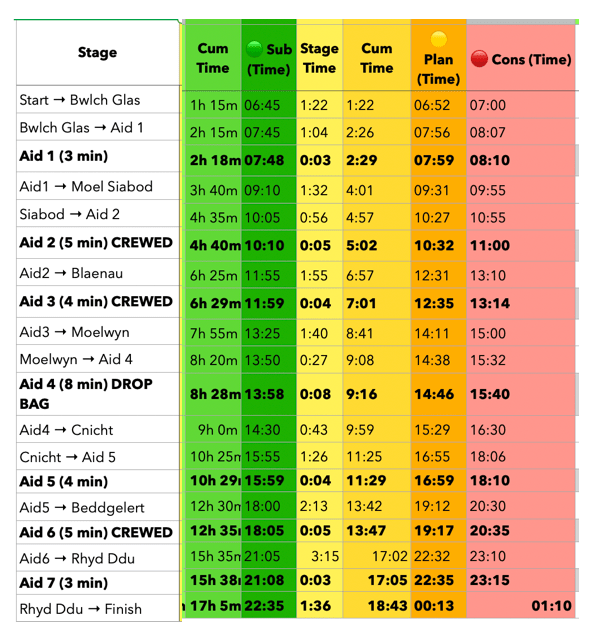
I now used this in 2 main ways:
- To plan my fuelling strategy – in terms of how many silicon flasks to carry with myself from the start, for my wife to give me at Aid 2, to leave in my drop bag for Aid 4 and then again for my wife to give me at Aid 6.
- I fed in my training weeks to ChatGPT and asked it to compare my training to the pacing strategy developed and wanted it to create a confidence score. I did this during the specific period and I would get replies of what it wanted to see (ie repeated downhill efforts) that I have already planned in, just not yet executed. So in terms of training, I was happy with what I had planned. Now this won’t run the race for me, but it does give me confidence in what I have done.
The last piece here was then to create Aid Station prompt cards, to help me reset at each aid station & prepare for the next part of the course. An example of what has been created below:
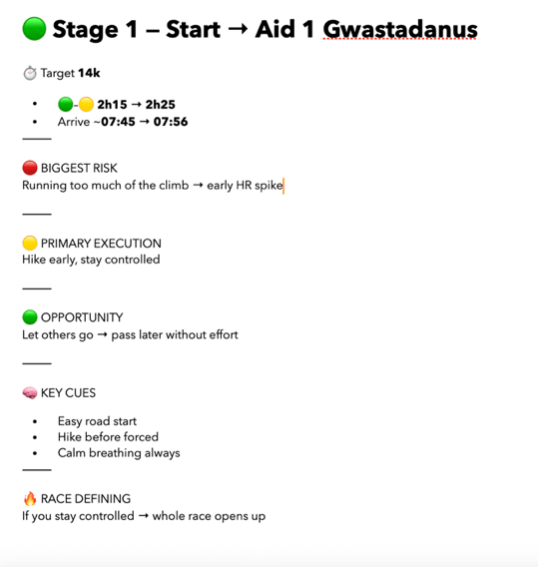
I have saved each one of these (there are 8) on my phone, to take a look at in each aid station, to remind me of what is to come.
This then left 5 – my why. This one has been interesting as my why has been:
Can I learn from what went wrong, correct and get it right?
I feel I’m half way there, but need to finish to really understand if what I did worked. I’ve also reframed this as not a race, but an adventure, something to explore and enjoy. Personally I find the word race very, very unhelpful in this instance. For me this isn’t a race, I’m not racing anybody. I’m looking to get stronger as the event goes on and finish feeling as strong as I possibly can.
Now I have the next 6 days to start. I am excited, feel well prepared and ready for whatever the day brings.
If anyone is interested in following ( to see how accurate or inaccurate my pacing is!) you can follow here:

