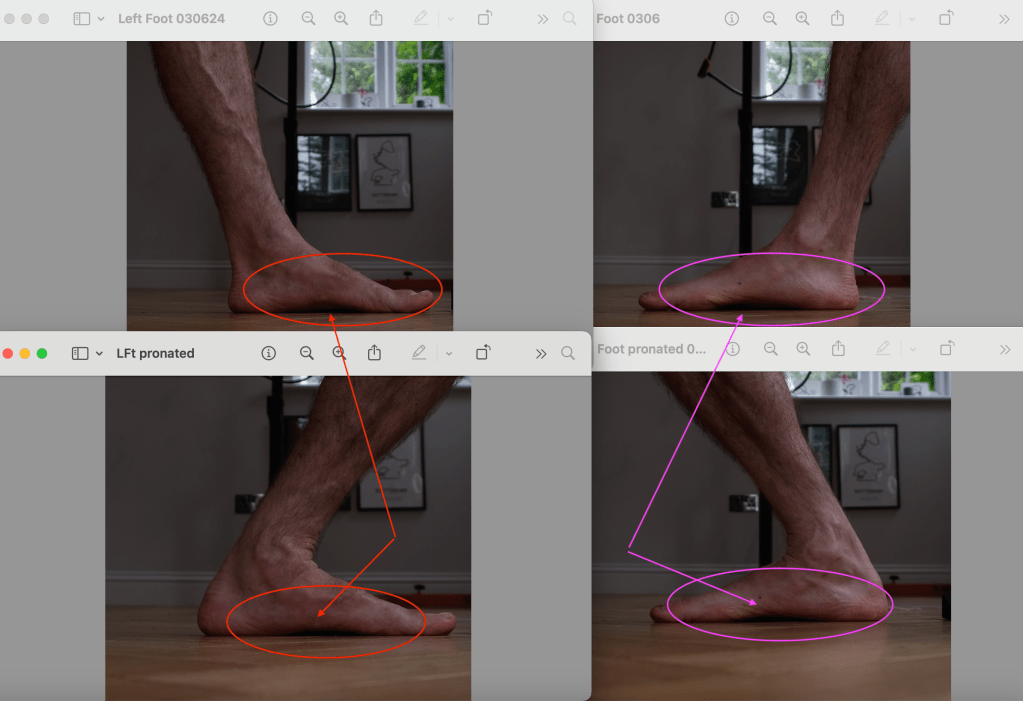
I’ve ben enjoying running again, mostly easy post the Snowdon experience, with the odd weekly faster session thrown in. During Saturday’s I could feel my right calf begin to tighten – reaching the point where I stopped just at the point where it would have been too overloaded. Thankfully a perfect stopping point. It felt exactly the same as the injury that interrupted my Boston training last March – and also something that seemed to have disappeared post protein supplementation from November of last year. Evidently not. Unhelpfully I was then due to go on a long hike for a friends birthday, which was pretty uncomfortable, but doable.
I then decided this was a good opportunity to look more closely at my movement to understand why the right calf (on this occassion) and not the left. What was missing / different between the two and how could I begin to correct and improve what was happening – which is what prompted the image above. I filmed myself using Gary Ward’s 8 movement’s to see what I could learn and here’s my initial findings with what I can see will be helpful to resolve.
- From the image above, of my feet pronating, my right foot barely pronates (whilst it feels it does, watching the video and taking stills I can see it doesn’t). When I compare to the left foot I can see a bigger difference once bringing my weight forward. The right arch fighting to stay there, the foot not wanting to let go from it’s supinated position and spread, taking the weight. This really helpful as immediately I know that with little heel movement my calf is being kept in a long position, the foot isn’t helping the muscles unload by letting the achilles shorten.
However the discomfort is towards the top of the calf complex and there is no achilles discomfort, so whilst the pack of pronation on my right foot is an issue it seemed to be linked to something else.
If I then look at how I bring load into my left / right feet below:
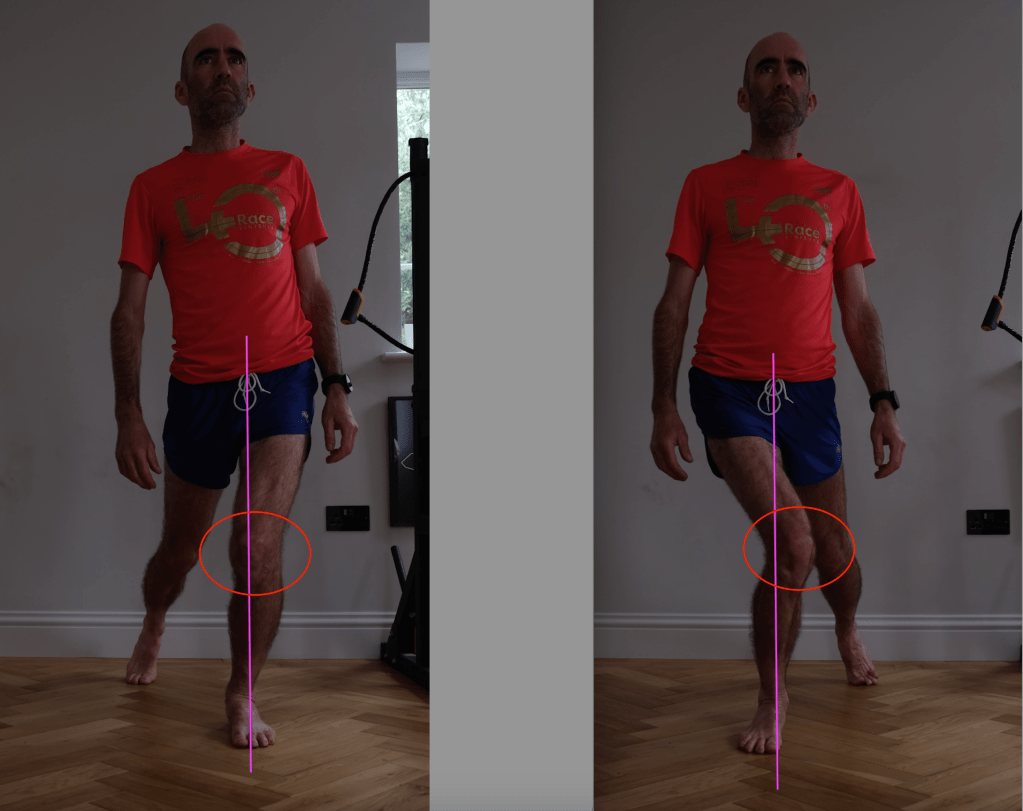
I can see that on my left hand side my weight is travelling over my first / second toes, importantly my knee is not moving inside the weight (the red circle) indicating that my hip / ankle / foot are doing enough together to help distribute the load.
If I compare this to the right hand side, when I come forward my bellybutton isn’t getting as far over my front foot (just over my big toe) BUT the big difference here is that my knee is shifting inside the weight, indicating that the hip / ankle / foot are not distributing the load effectively. This would make complete sense with a foot that finds it challenging to pronate. As load comes down the leg on foot contact, with the ankle / foot remaining rigid as opposed to spreading and taking the load, this gives the knee no option but to drop inside. The outcome of this – something now has to assist in pulling the lower leg back as the knee extends. For me it appears that this has been overworking the top of my calf.
The next thing I looked at was the difference left & right in terms of shifting & accepting my weight:
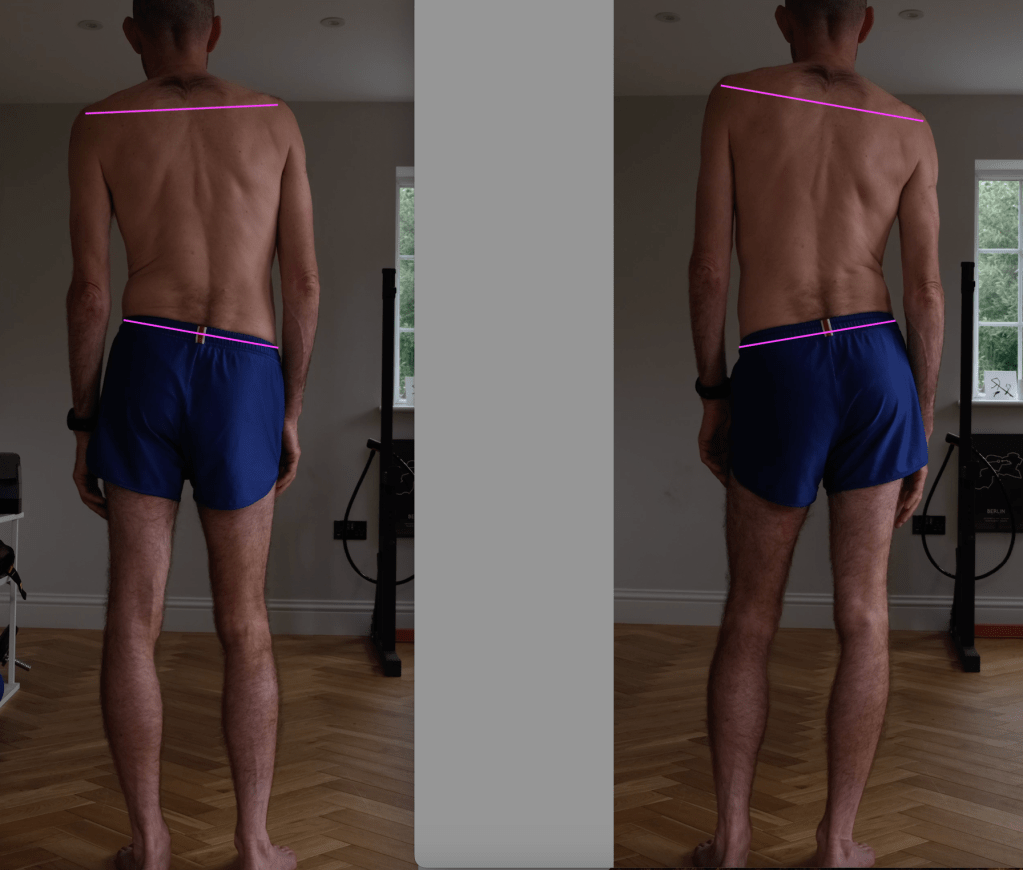
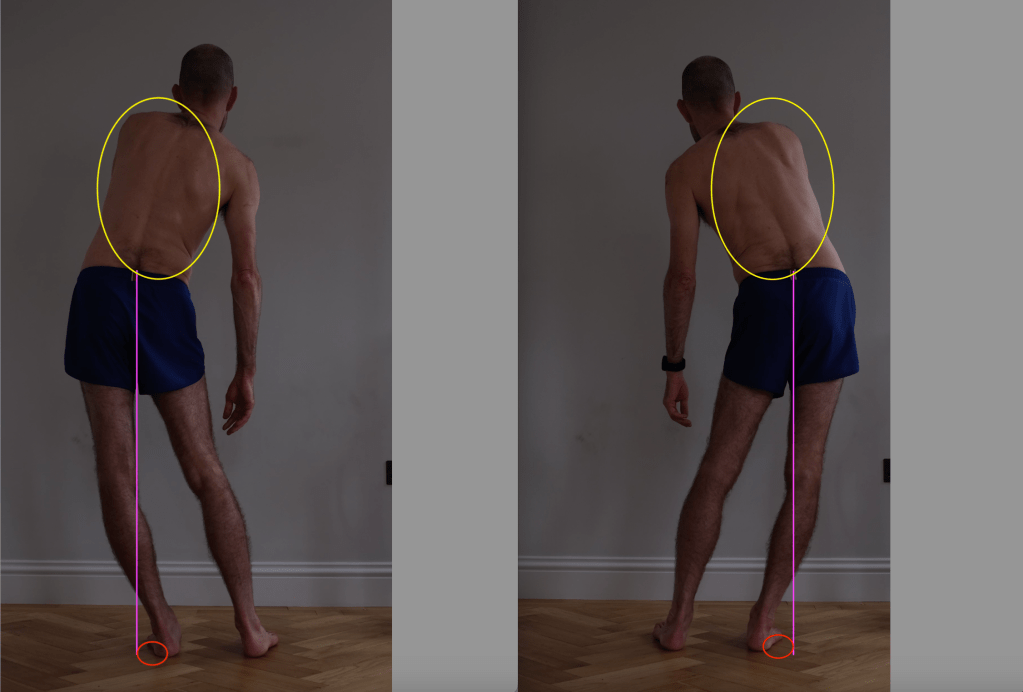
The first thing that is clear is just how little movement / lateral (sideways) movement I have in my upper or thoracic spine. It also looks straight, tense and locked up.
The second thing is it appears I have slightly more movement in shifting my weight to the right, which is fascinating as it looks like I am unable to accept weight as much in my right than my left when lunging forwards.
Having seen all of this I can now lay out a next steps for me to work on, whilst taking some time off running to let my muscles recover and rebuild.
- Give my right foot the experience of pronating. I need to reduce the pressure on the load stopping at the ankle, letting the knee dive inside and get the foot to spread. Wedges for pronation exercises, using a tissue to give me physical feedback on the arch dropping, moving a pen with my big toe and imagining my heel rolling back whilst plantar flexing
- Isloate my right hip as far as possible, getting better movement in the joint to active the glute medius to help compensate for the lack of movement in the foot. Historically three exercises I’ve used here have been a hip capsule opener, a wall supported hip hinge and sweeping one foot back whilst supporting weight on one foot. Whilst I am building the foot up the more the hip can do to support my body as my foot hits the ground the better.
- Begin to loosen up my thoracic spine. Finding space and rotation here is going to allow movement a smoother path throughout my whole body.
As always little and often will work well for this. So at least 2x a day if not more, 5 reps on each movement, slowly, carefully and really engaged to help rewire my brain and let the joint movement support better movement and relieve the discomfort in my calf – and prevent from reoccurring.
 BreatheToMove
What a great way to really see your ‘angles’ – I should do this with my scoliosis – I know I’m out of alignment, but haven’t been photographed in decades… Thanks for the prompt, Linda 🙂
LikeLike