I’ve looked at the shoes on the feet of the top 10 athletes in Boston & London the last week.
Boston first:
What struck me is it felt like a broader range of shoes on the feet of the athletes, than has been previously the case (possibly recency bias on my part). Watching this yesterday I was pleased to see a variety on the feet of the athletes, which suggests a more level playing field. This unlike mid-distance track events, which are utterly dominated by Nike athletes. Checking what was worn you had:
- Sharon Lokedi (KEN) – 2:17:22** Under Armour
- Hellen Obiri (KEN) – 2:17:41 On
- Yalemzerf Yehualaw (ETH) – 2:18:06 Nike
- Irine Cheptai (KEN) – 2:21:32 Nike
- Amane Beriso (ETH) – 2:21:58 Adidas
- Calli Thackeray (GBR) – 2:22:38 Nike
- Jess McClain (USA) – 2:22:43 Brooks
- Annie Frisbie (USA) – 2:23:21 Puma
- Stacy Ndiwa (KEN) – 2:23:29 Adidas
- Tsige Haileslase (ETH) – 2:23:43 Adidas
Under armour – 1
On – 1
Nike – 3
Adidas – 3
Puma – 1
Brooks – 1
- John Korir (KEN) – 2:04:45** ASICS
- Alphonce Simbu (TAN) – 2:05:04 Adidas
- Cybrian Kotut (KEN) – 2:05:54 Adidas
- Conner Mantz (USA) – 2:05:08 Nike
- Muktar Edris (ETH) – 2:05:59 Adidas
- Rory Linkletter (CAN) – 2:07:02 Puma
- Clayton Young (USA) – 2:07:04 ASICS
- Tebello Ramakongoana (LES) – 2:07:19 Xtep
- Daniel Mateiko (KEN) – 2:07:52 Nike
- Ryan Ford (USA) – 2:08:00 Puma
ASICS – 2
Adidas – 3
Nike – 2
Puma – 2
Xtep – 1
Another thing to bear in mind is how much difference each shoe made, on the day, for that marathon. So John Korir runs 2:02’44 @ Chicago last 2024, 2 mins slower than yesterday. However Conor Mantz runs 2:07’47 Chicago 23 and over 2m 30s quicker at Boston yesterday. On this basis is the Nike Alphafly a better shoe to choose than the Asics Metaspeed?
This is where you can become a little unstuck, as just focusing on the winning shoe won’t necessarily give you the best shoe that leads to the biggest improvements. And that’s before you even get into the many other variables that feed into a good marathon run.
The new Puma shoe is an interesting case.
Linklater & Tiernan on the men’s side are Puma athletes.
Linklater ran a big PR (2mins from a flat course) Tiernan not & outside top 10
Ryan Ford chose to run in it (EDIT from listening to Let’s Run this AM days before the race!!!) and big PR.
Annie Frisbie big PR.
Again how much is the shoe, experience, aging, training, coaching, who knows – but from Puma’s perspective it looks good when they can come in with a new shoe, a lot of noise and get 2 top 10 men and 1 top 10 woman.
I’ve not heard of Xtep before – interesting that they are able to produce a shoe that places top 10 in the men’s race.
Equally noticeable is a lack of any New Balance athletes top 10, as lead brand sponsor for London this strikes me as a challenge for them.
Other potential misses, Saucony & Hoka. I wonder how this stacks up for where they see themselves and whether this is a problem for them or not.
Then London:
Womens
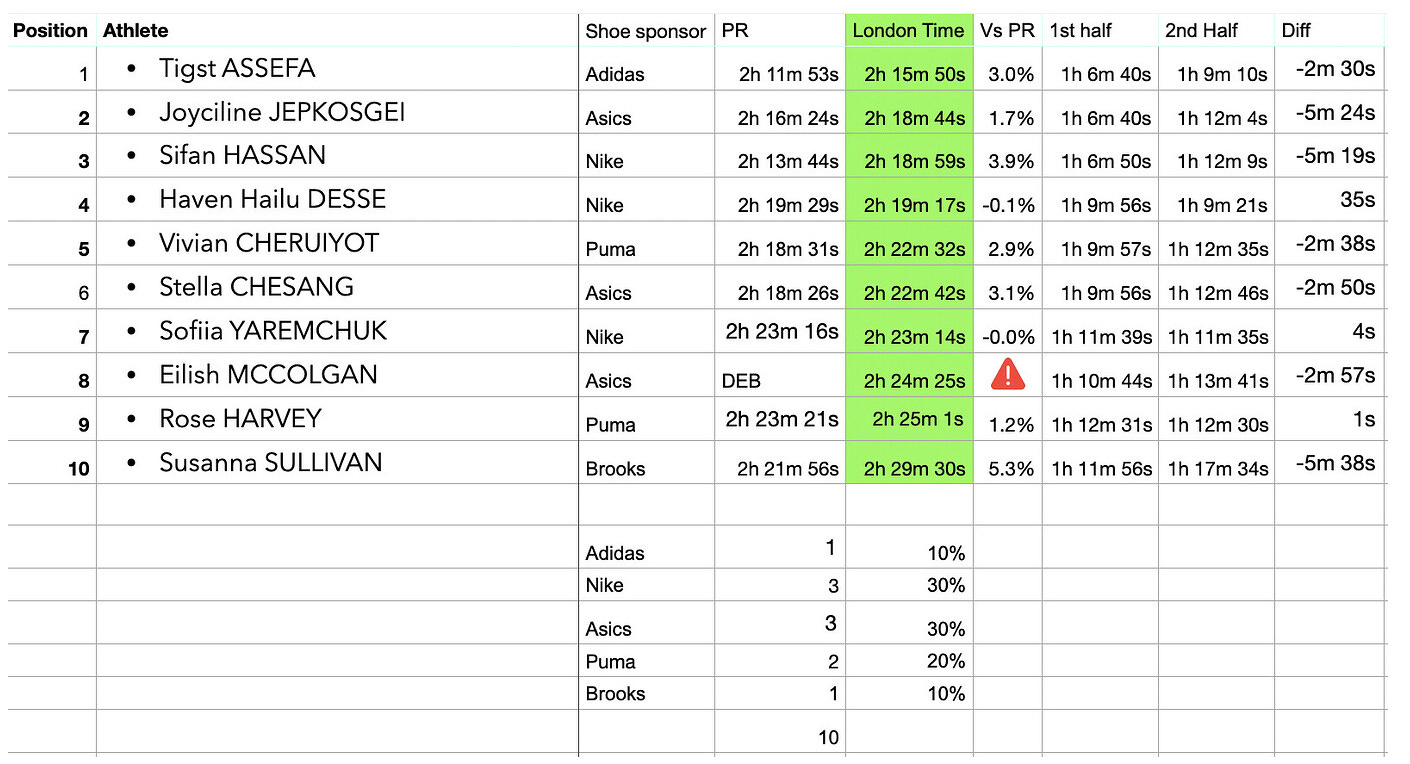
Shoe wise vs Boston – again breadth in 5 brands, Nike same, Asics athletes favoured running London? or something esle – 3 here none in Boston top 10. Puma 2 in top 10, so a success for their campaign.
Adidas possibly bitter sweet, launch of the new Evo 2 and a great run from Assefa, yet from 3 top 10 athletes in Boston to 1 in London, not such a good look for their new shoe.
Mens:
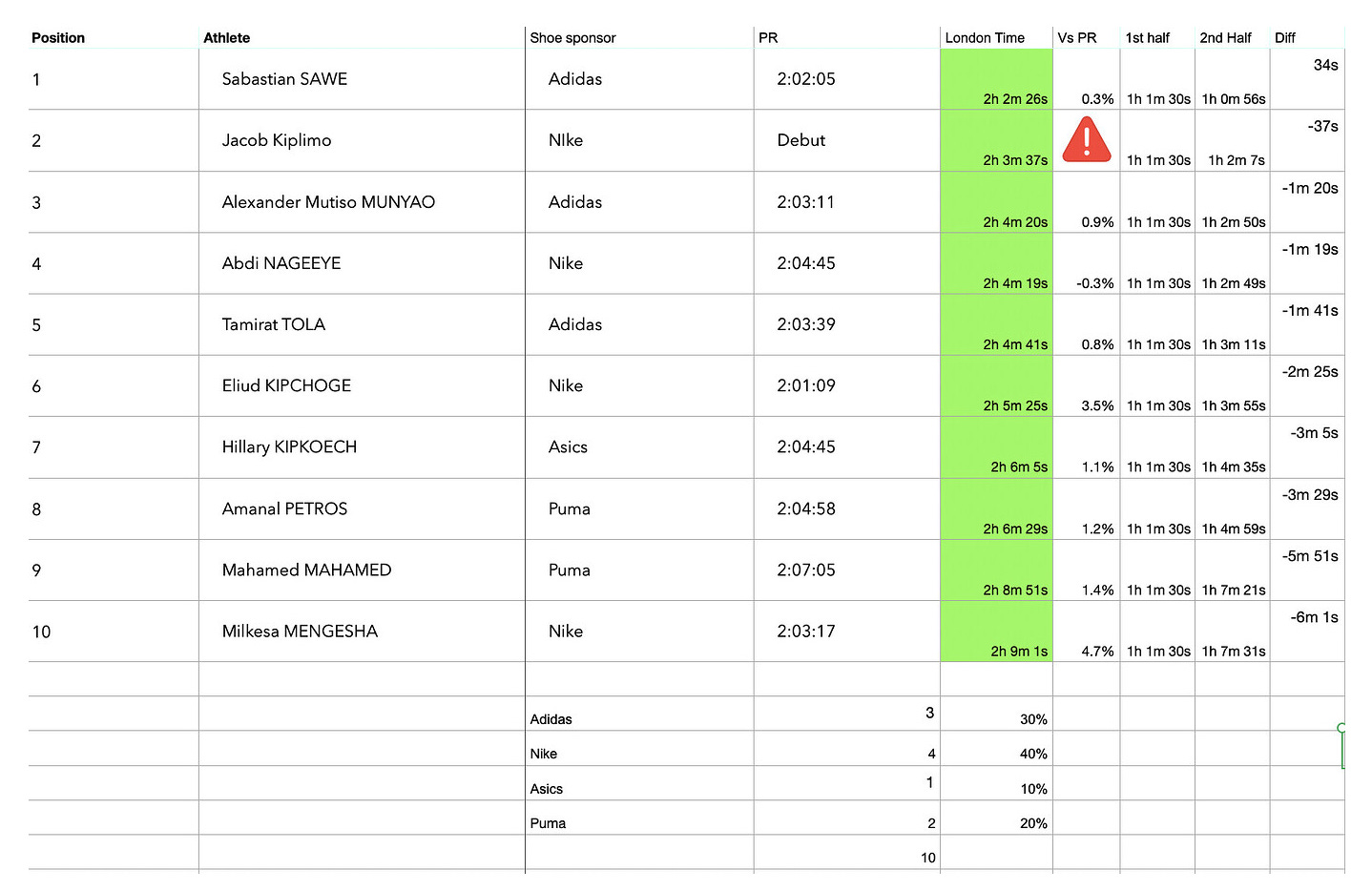
Nike athletes prefer London? who knows, but 4 top 10 here to 2 in Boston.
Adidas would be happier on the men’s side, with Sawe winning – and having him as an Adidas athlete is a great look, as he looks some marathon runner, and 2 other athletes in the top 5 a good result for them. Puma another 2 top 10 – one being Petros who must have been a recent signing from Adidas.
Less variety here in the men’s top 10.
I’d say that Nike / Adidas will be happy, satisfied with what they have seen, but not overjoyed – kind of 7/10 in terms of placings and performances.
I suspect Asics will fall into this camp as well, good result on the women’s, 2nd women & top Brit, not so good on the men’s.
Puma – these guys must be pleased, new shoe, big fuss and for the second week in a row top 10 finishers.
An aside on Brooks – I imagine they are pretty pleased. A US specific running company who have shoes on the top US women’s finisher, this a really good result for them.
New Balance – race sponsor and no top 10 result, this can’t be something that they are happy about. Especially when Puma come in, lots of fuss, new shoe and get the results that they just have.
Why does this matter – It’s an interesting point – I suppose it’s slightly nuance combination of how good the shoes are, how good the shoes are perceived to be and which brands sponsor which athletes which I am really interested in.
Seeing how much breadth is on the feet of top athletes helps understand how healthy footwear competition is at the top of the market & from this how much less influence 1 single company has. When Nike launched the Vaporfly in 2016 this felt like a seachange and a shift in control / influence based on one company with 1 shoe. This not the case now.
I also see it as really interesting which athletes wear which shoes – or brands – as in all honesty the brands have 1 top level marathon shoe rather than several. I also suspect this is of great, great interest to the athletes themselves. Fundamentally they want to win and wear the best shoe that will help them do that. When the top athletes come to renegotiate / negotiate contracts & lock themselves into wearing a shoe at this point they are making a shoe choice. Do they want to be a Nike, Adidas, Asics, Puma or whomever athlete? I get that only a handful of top tier athletes get this choice, but this is absolutely critical for both the shoe companies and the athletes. Sawe and Assefa have chosen to run for Adidas, they felt this the best option for them. Whilst I have no idea of the contract offered & I am under no illusion money plays a huge part – they will want to win and feel the shoes that they are wearing are going to give them the best opportunity to do this.
Petros was dropped / left Adidas and moved – he ended up with Puma. It would be interesting to know why Puma over and above anyone else, no offers, or a better shoe for him to run in over and above other offers.
An aside – In trail Katie Schide & Germaine Granger have just switched from North Face to On. I can’t imagine it was just the money – the shoe that On has must have persuaded them it was worth to switch. Which they both pretty much say is why when interviewed about this.
Then you have the knock-on success on the roads feeding into the general sense of success for the brand as a whole – showing top level results in a road marathon must filter down through footwear development throughout the company and this will have an influence on the mindset of young up and coming runners looking to sign their first deal.
I’d certainly agree that it is really, really hard to ascertain which shoe is superior based on the results of major marathon, but this isn’t actually necessary here for the brands. What matters is the perception to the watching world that the higher you come, the better the shoe must be that got you there. This is where the shoes marketability comes into play – bottom line how much money the shoe will make the company and this is a key point for the shoe companies. Whilst an excellent scientific study on the various shoes efficiency is far more reliable, it is less effective to the watching public than seeing a brands shoe on the feet of an athlete placing highly. This has more reach, more immediate impact, so is of far more importance.
 BreatheToMove