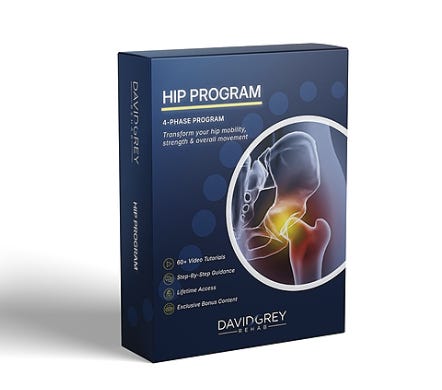
One of the best things that has come out of my knee injury is buying / starting / using David Grey’s hip program. Having looked at my movement, ascertaining just how weak my right hip is & discovering no improvement post snowboarding I decided to buy David’s new Hip program to help try and resolve my hips weakness.
I was introduced to David’s work via a coach on the Scholar program forum 2-3 years ago. David sits in the same realm as Gary Ward, Dom Koch, Conor Harris, etc. Guys who have a really clear understanding of how the body moves and using really specific, well coached movement to help reintroduce range of motion into joints & therefore muscles. A keen eye, patient mind, encouraging manner and passion for the subject at hand incredibly key to helping solve movement problems.
What I particularly like about David’s courses are the mix of mobility & strength in what he offers. I had previously bought his foot & achilles program to build out my library of solutions to offer athletes (notably someone new I was working with that I wanted to have some structure to help get them back to fitness or manage any backward steps). With what I had observed in my own movement, it seemed a perfect coincidence that he has just released a hip program.
His opening pricing offer made the course around £100 – which for me was a fair price. My ultrasound had thrown up nothing serious, so rather than pay for a series of physio sessions I felt it a far better investment to buy David’s program and follow it diligently.
The course itself is set up in 4 phases. Each phase has 3 separate days to follow (other than phase 1, which has 1 day to repeat). David gives advice as to how long to follow each phase for. There is an outline of the phase itself, each day in each phase and clear videos for every exercise to carry out. This is invaluable as you are provided with a short video, showing David coach the movement in question, with cues to follow and challenges to avoid. What I’ve found helpful is to watch the whole day in each phase completely, trying to understand how to carry out each movement before then running through the whole program.
Having just finished the first phase I certainly feel a lot more in tune with my hips – having only needed 3 days for this I haven’t expected any kind of lasting change, but found running for my knee pain free and enjoyable (hopefully reminding my hips how to join in enough for now, as I slowly come back to running). After 6 – 8 weeks I’d like to see better single leg control / balance. Timings wise it hasn’t taken the 25 minutes as David suggests, but from 45 to 32 (45 minutes was a lot of fussing and correcting). However 30 minutes seems a far assessment of time needed to carry out the day’s phase.
I’ve given myself 8 weeks to get through the 4 phases. As I do so I’m making a note on the specific exercises I found particularly helpful for me. To date the 3 that I’d look to integrate on a more long term basis / daily mobility are:
- Kickstand hinge with 30sec hold on last rep. I’ve found that the 2 leg kickstand hinge really encourages external rotation in my right femur, whilst my right foot is grounded. This reducing the external rotation in my knee and helping/reducing my natural left rotation in my pelvis. This feels good and something my body likes
- Side lying glute clam + Adductor pull backs. The small cues and subtlety of movement here allow me to feel both my adductors & glutes as my femur / pelvis is very slowly and deliberately moved to ensure that I am giving length to muscles that miss it. I see this as an important part of turning on nervous signals that haven’t been as fully functioning due to being underused.
I’m now moving onto Phase 2 and am looking forward to finding the movement tricky, to less tricky, to smoother as my body adjusts, adapts, learns and hopefully strengthens.
All of above wouldn’t have been possible without my knee being unable to carry on.
The phrase it’s happening for you has been uppermost in my mind over the last few days.
 BreatheToMove