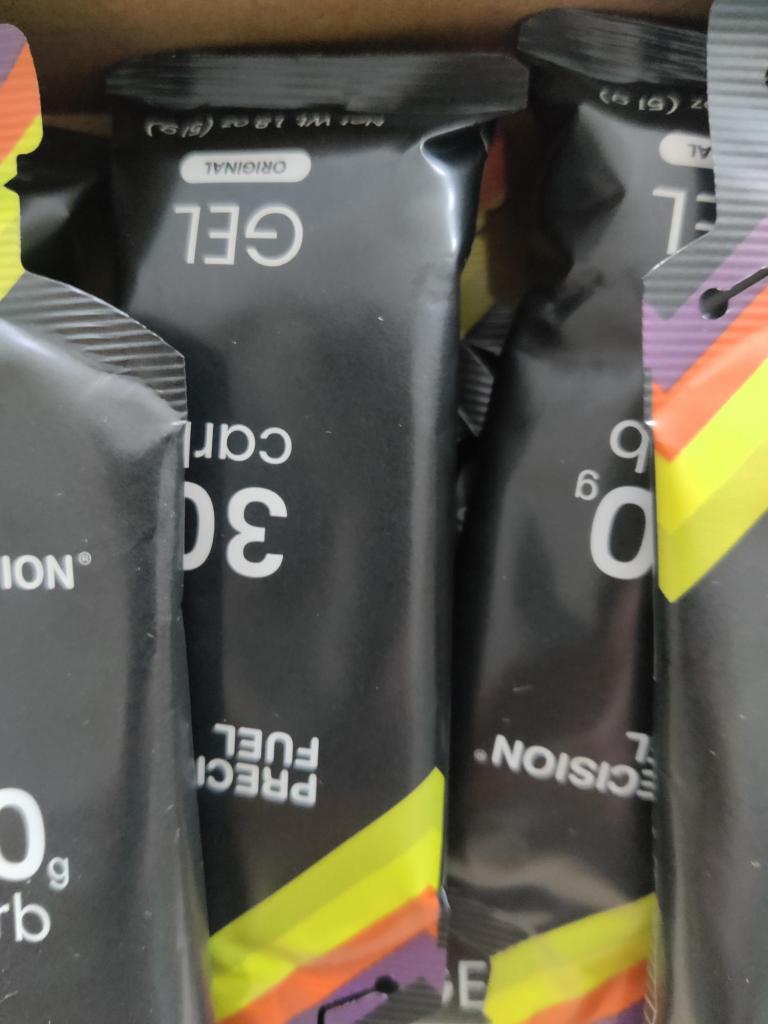
The 2 biggest shifts in marathoning, over the last few years – for me – are the shoes & fuelling. The days of using jaffa cakes for a marathon are long gone (which were perfectly adequate for ,y marathon debut in 2004 running round New York, if not a little dry). The advice of 60g / hour as a ceiling for fuelling has been shifted up & up over the last year. There’s been an increasing amount of studies written about this. David Roche has been highly vocal & transparent around how he’s fuelled his recent ultra successes, (where he also sees Bicarb as a key to his success).
One of the things that fascinated me about this was when I read how Yiannis Kouros fuelled his Sydney to Melbourne run in 1989:
In total 13,340g of carbs.
Rest 9h 55m
Sleep 4h 40m
Non moving time 14h 35m
Race took 5 days 5 hours, so moving time 110h 25m
Avg carb intake 120.8g/hour.
Day 1 he was averaging 140g / hour (see nunbers below from image)
What is surprising for me is it has taken so long for the current carb loading approach to have been reached. (From Katch & McArdle exercise Physiology)
Far closer to the 120-140g/ hour that many elites are now using in races.
How does this then trickle down the running vine to non elites. How much fuel and how to adapt. I remember first reading Maurtens advice on their fuelling guide for 6 25g gels in a marathon (1 every 6k) and massively struggled to take on the gels. Like everything this can be trained and this has been a conversation / question asked over on the Science of Sport discourse channel.
Dara asking:
So what I’m curious about is which would be more optimal in training: matching the race rate of fuel intake but over shorter distances, therefore less total fuel compared to the race, OR train with the total amount of race fuel over shorter distances, therefore over-fuelling in terms of the rate of intake but matching the total intake planned for the race? Or perhaps it should be a combination of the two
My answer to this is two-fold. First part is:
I think here it depends on the intensity of the session, and falls somewhere around you’re last comment of a combination of the 2.
I’d agree it’s unlikely (but not always out of the question) you’ll run a marathon, at race pace, in a training block, but you may well run a high (85-90%) of your effort/pace over a high (85-90%) distance in your training.
If you target 4:00/km for your goal pace – it’s a nice round number. You run a long session (say 38k in total) which has blocks of marathon pace. The pace averages out at 4:24/km for the whole session.
You’ve run at 90% of goal pace for 90% of the goal distance.
Total time on feet is 2h 47m
You’re at 90% of distance & 90% of time, pretty close to what you are going to run on race day & would be likely to do this 3-4 weeks out.
If you drop back the distance to 34k & avg pace to 4:36/km (again with blocks of marathon work) you’re at 80% distance at 85% goal pace.
Whilst imperfect I then think about what I’d like to be able to fuel on the day (lets say 90g carbs/hour)
So if I’m running at 90% of goal pace then I want to be able to take on at least 90% of my fuel needs / hour – so 81g/hour.
If 85% goal pace then 75g/hour.
Then using the total time run I can workout how many gels/timing of gels based on the carb content of each gel / bar / carb drink.
This helps build out a fuelling plan, to bolt onto long runs, as the runs get longer and you look to adapt the body to roughly the amount of fuel you are using for each run in question. It also helps build a tolerance / hour based on the intensity you are running, that is focused on your marathon effort. It is also, hopefully, close enough to what you need to not cause GI distress or leave a fuelling gap in what your body is after
If you get your race target carb/hr fuel right it should help avoid over fuelling.
The second part is – what if you have been barely fuelling / not at all, which was far closer to where I sat in 2017/2018 when re-discovering the marathon distance. I think here you start with your target for the day itself. Let’s say for arguments sake a 4 hour marathon 50g of carbs an hour, for a 3 hour marathon 60g an hour. I’d then look at reducing this target amount by 10g an hour for every 4 weeks that preceded the marathon. So on a long run 3 months out you’d be targeting 30g / hour for a 4 hour marathon or 40g / hour for a 3 hour marathon.
Then it’s a case of planning regular time intervals to take on board the fuel (every 30 mins a good starting point) based on the length of the run you intend to carry out.
Whilst all of above is far from backed by science, it does provide a framework to support fuelling on longer runs, which is progressive and allows runners to gradually train how to fuel, getting them closer to something that will help sustain them throughout a marathon.
 BreatheToMove