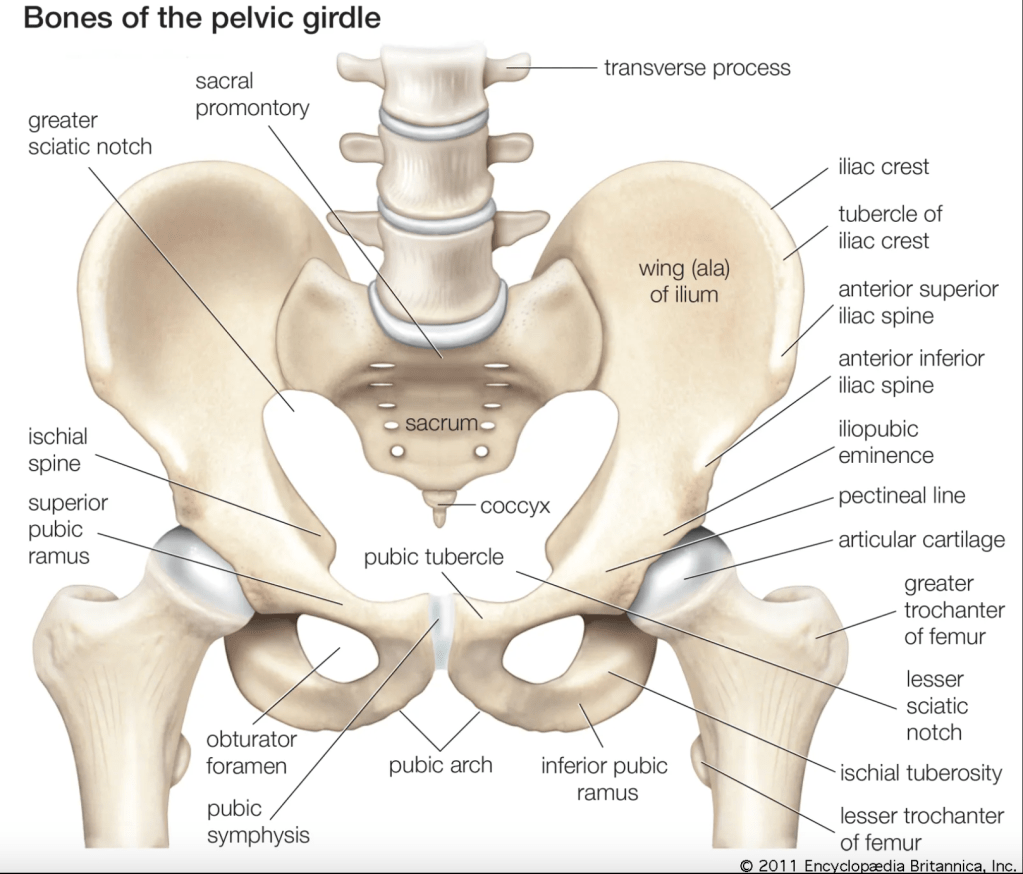
I’ve been thinking about all of the impact that the pelvis has on movement – realising that if I’ve learnt anything over the last 4-5 years is just how little I do actually know. With this in mind the first thing I wanted to do was take a closer look at the pelvis itself (leading me to the above image). There is something inspiring & confusing when I open up / look at more scientific based imagery. Inspiring as I wonder at all the various parts, names, elements. Confusing as I wonder at all the various parts, names elements. And this is purely the structure, skeleton, joints without the myriad of fascia / muscle / tissue / nerves / lymph / veins / arteries etc superimposed over the top.
That aside I like the simplicity of what the pelvis can do in movement terms:
- Hike up / drop down
- Tilt forward / Tilt back
- Rotate forwards / rotate backwards
All of which impacting structures above / below. The spine, ribs, arms, head above. The legs, ankles, feet below.
All of the structures above / below impacting the range of movement in each of those 3 options above.
Making the pelvis this wonderful cross roads of movement. The place where everything – helpful or unhelpful manifests itself before crossing over from above to below or vice versa.
How is force transferred, how much force is transferred, can force be transferred, where does force go?
Bringing this back to running there is so much that the pelvis can tell us – help with. Too much forward (anterior) tilt at rest is going to have the impact on the lumbar spine being extended and the femurs internally rotated. How will the body respond to this resting position – will knees turn out to try and compensate for this? How will feet respond, ankles? Will the thoracic spine / ribcage flex to minimise the excessive lumbar extension? Is your breathing affected with a more inhalation based resting posture?
Will all the opposite happen if the pelvis is resting in a more backwards (posterior) position?
I remember the first time I connected the movements in the wall cog exercise – where you stand with the top of your pelvis, shoulders & back of head touching against a wall; bare-feet flat on the floor. Then you tip your pelvis forward looking to see what happens. What became more eye opening for me was reversing the movement, tilting my pelvis back and feeling my normally over extended lumbar spine flex and flatten into the wall. My ribcage dropping forwards, the back of my neck lengthened as my chin began to tuck into my chest. The aha moment came as the weight on my feet moved from the rear / inside to the front outside as my feet moved from pronated to supinated. Connecting the dots in this way via the focus on the pelvis really instructive in how we can connect the pelvis to what is or isn’t happening.
The other plus point from the wall cogs was tuning into how my hip joint was moving in response to my pelvis moving. Tipping forwards leading to the femurs internally rotating, reversing this leading to my femurs externally rotating. Whilst I was standing against a wall this meant that my pelvic movement left the legs / feet with no option but to respond – however well or limited they could. So it then allowed me to begin to understand what impact this would and could have when walking or running – without the restriction of a wall. If you are stuck in one position then how can all of the other movements happen with full range & fluidity. If there was a lack in movement what would then pick up the slack? What would sit out completely and be redundant. Equally this then helps understand if these areas have the balance of movement changed how capable will they be in managing this. A pelvis that lives in a place the results in limited hip extension, when given improved hip extension how are all the connected tissues going to respond by suddenly increasing the force that runs through them? Something else to consider – the combination of improved mobility needing coordinated strengthening.
I’ve been enjoying helping my pelvis out over the last week by addressing what’s going on above and below. This seems to be helpful in balancing the flow of energy / force and reducing the impact that my right calf was suffering due to a body out of kilter. Lesson to look after the movement’s I need throughout my body.
 BreatheToMove