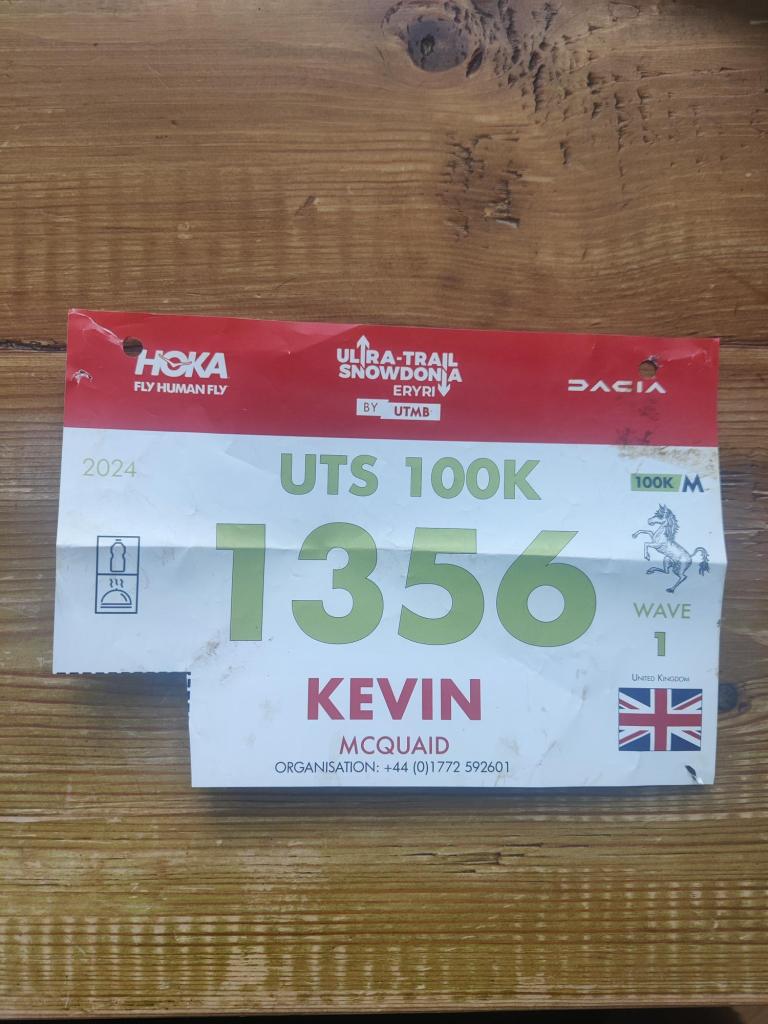
My race number – minus the corner cut off following my DNF at halfway.
I learnt so much from Saturday’s UTS 100k. I got so much from the whole experience, the training and the day itself – more than I expected – so whilst I’m a little bruised, battered and physically uncomfortable today, I’m more than happy with the outcome and am so glad I took part in this.
The race itself follows the path below, I’ll come onto the course elevation and impact later.

Pre race planning:
In terms of what I was running in I decided that my Salomon Slab Ultra 3 shoes, they seemed the most suited to the varied terrain, a pair of half tights & running T. Running pack was the Salomon 12L Adv skin, with the Salomon pole quiver, Leki Ultralight FX-1 poles & Soar running cap, 2 500ml silicon flasks & 1 1.5l hydration pack to use on the longer sections. Alongside this was all of the mandatory kit in my running pack. I’d definitely change the running quiver to an elasticated belt to pack the poles in horizontally, as this became a little bit of a pain as I progressed and involved too much of getting the pack on/off. Everything else worked well – especially the poles.
Fuelling – I packed 4 x Clif bars / Maurten caf / Maurten non caf gels & 8 electrolyte tablets. In my drop bag was the same amount of clif bars & gels, so by the time I’d reached half way I would then completely resupply. The intention being to take a bar / gel every 47-50mins (so 25g of carbs) which I’d then supplement with food at the aid stations.
I’d wanted a very rough estimate of my times, so created a predicted estimate that I thought I wouldn’t be faster than. Here’s the times with how I fared against them, until I pulled out:

The race starts in 2 waves, 4:45am & 5am. I was starting in the 4:45 wave. With this in mind I didn’t want to be up to much earlier – to maximise my sleep – and as I was staying a 20mins drive away got up at 4am and arrived at the start line at 4:35AM, so no hanging around. The temperature pre sun rise was already around 11/12 degrees, which reinforced the fact that the day was going to be warm (which it was) but heat isn’t really that much of an issue for me. What it did mean is I could start in a T-Shirt, rather than a jacket that I’d have to take off later.
This is where I’ll add in the course profile:

What I cognitively knew from this that there was a lot of elevation, split aggressively over 8 peaks, with a couple of small bumps along the way. I knew that it would be a lot of up, then back down, with not much runnable stuff until post Peak 4 Carnedd Llewelyn. I was aware that the key to this was getting to that point relatively fresh and looking forward to a decent sized sit down hot meal at Capel Curig.
What I didn’t fully comprehend/allow for is just how physically demanding this would become, the strain of straight up / straight down on really technical terrain. With hindsight this is now abundantly clear to me.
In terms of the race the first climb felt good, as did the descent coming down to Pen-Y-Pass. I got into what felt a really sustainable, comfortable rhythm. Enjoyed bouncing down to the first aid station, settled into running alongside another guy and was really happy.
First mistake, was too fast and needed to be easier
Reached the first aid station and here there was only NAAK energy products & no proper food (which I’d had mentally to eat) so I ate none of what I saw as the same as what I had, refilled water bottles and carried on.
Second mistake as I was now behind in my carb intake, but yet to feel it
Second climb was a lot harder than the first, but still felt good, happy taking lots of little footsteps on the steeper parts, not looking too far ahead, just focusing on one step after another to get to the top. You then have a steep drop down to the start of the 3rd peak. Up that then dropping into Glen Dana 2nd aid station. I was beginning to feel a little fatigued, but nothing at this point that felt out of kilter with how long I’d been going or what I had climbed over.
Reached the 2nd Aid station, at this point you could have assistance so I had my wife meet me, fill both my 500ml flasks, 1 with an electrolyte tablet as it was beginning to get hot and my 1.5ml hydration pack. The next water station was over 18km & over 3 hours away so I wanted to ensure I had as much water as needed. I ate an orange and 2 slices of melon, they tasted amazing and what I didn’t do is eat any of the sandwiches that had been made. My brain just didn’t want them.
Third mistake – on reflection the response to the fresh fruit showed how much I needed proper food alongside the gels / bars I had – which were supposed to supplement not replace aid station food.
I left the aid station feeling good and ready for what I knew was the key climb. I knew it was long & hard after the previous 3, I also knew once I had this out of the way I had a decent amount of easier running down to Capel Curig for a nice sit down, lunch, reset and onto the second half. The climb up to the peak just before Carnedd Lleweyln broke me. It was amazing how fast my fatigue ratcheted up. For the last 1km of the climb I recognized that the fatigue I was feeling was energy related, having been in this situation before. I ate a Clif bar, which by now tasted awful and had to be forced down. I then took a tumble coming down some shale/ gravel just over the brow of the first part of the climb, bruising my knee and elbow. At this point I knew that the tiredness / discomfort I was feeling was part of the experience and a result of going out a little too hard & not eating any food at either of the aid stations. I had to focus on getting to half way to eat there. The next 30 mins were tricky, wondering if I could finish begun to creep into my thoughts. I had another gel around 10 mins before the summit, summited and begun to feel better, which boosted me a lot. Only to be followed by a large tumble on looser shale / gravel coming down. Took a lot more skin off my knee / elbow / hands & hit my hip. I sat up as wasn’t at all sure I was OK, few runners stopped to check. Thankfully was all skin wounds. However now I was pretty worried about another 70k in the mountains as I knew I had fallen due to tiredness. The idea of coming down mountains 90k into the race, in the dark was now something I didn’t think I would be able to do:

For the next 50 mins I went back and forth in my mind about carrying on – knowing that once I was out, I was out. What put the final nail in the coffin was a distinctly runnable downhill section. I started trying to run it and my quads were done, I couldn’t run it. I knew that I was past the point of recovery, now I didn’t trust my body to get me safely round the course. I still had 4 big climbs / descents to come post Capel Curig and I felt at this point to carry on (having fallen twice and unable to run a downhill) past half way was utter stupidity. I called my wife and let her know I was done and was going to walk / run into Capel Curig and enjoy the 13k I had left. I was able to run / walk until around 43k when I felt that walking was the best option and enjoyed the walk into the Capel Curig. The poles here on the downhill stretches were absolutely awesome.
Pulling out at half way felt great, no regrets. I felt I’d got so much out of the experience at this point.
Reflecting on the whole event / process afterwards I have learnt so much:
- Before the event started my why for doing it had been met. I wanted to do this as I wanted something to take me to a different place, to give me a challenge I didn’t know if I could finish. What I learnt in the training is just how much I missed marathon training, how much I didn’t like running with a full running pack on and exactly how I like to structure my day. I love the feeling of running at a controlled pace for a long time, not every run, but at least once a week. That’s what makes me tick as a runner, that’s the purpose running serves for me, and that’s not what ultra mountain running gives to you. So come race day it didn’t really matter to me if I finished or not, I’d already got out of the race what I wanted without realising. I knew how I wanted to run going forwards
- UTS 100km / 100miles is very hard, probably more challenging than many other ultras – which was the consensus of a lot of the other experienced ultra runners there. It isn’t so much the elevation, as the relentless straight up and down of the climbs. The gradients & technical sections that make the race so taxing. I mentioned earlier I knew this cognitively before the race, from looking at the profile and having been to Snowdon. What I really didn’t comprehend is just how this translates to physical demands, which in turn leads me onto training
- I haven’t got the desire, drive or patience to train for this kind of race again. I knew as I was walking back to half way that what it would take to train for the 100km race isn’t something I’m interested in doing, at the expense of what I am interested in doing. And this is OK – in fact this was a very comforting thought.
- I love running in the mountains, just not for so long. I’d be more than happy to run up to 55k – and may well come back to run the 50k race here. The mandatory kit list is lighter, with 4 climbs more evenly spread out, which to me seems more forgiving and something more achievable. Here by halfway you’ve covered 2 ascents & 1 descent. This in comparison to 3 ascents / descents in the 100k

5. Stopping is an important option to have and consider. I was able to make a sensible decision, that wasn’t hurried, that ended up taking my ego out of it and being objective about whether I could carry on.
6. The best laid plans pre race can fall apart – what is the security blanket? For me if I had had my wife bring me potatoes / rice cakes at the second aid station I may well have been able to run further. Who knows.
7. I love running at big events.
I wanted to know if I could finish – I couldn’t.
I wanted to find my boundaries – I did.
I wanted to learn about myself – I did.
In those terms this was a great success and something I’m incredibly pleased with.
 BreatheToMove