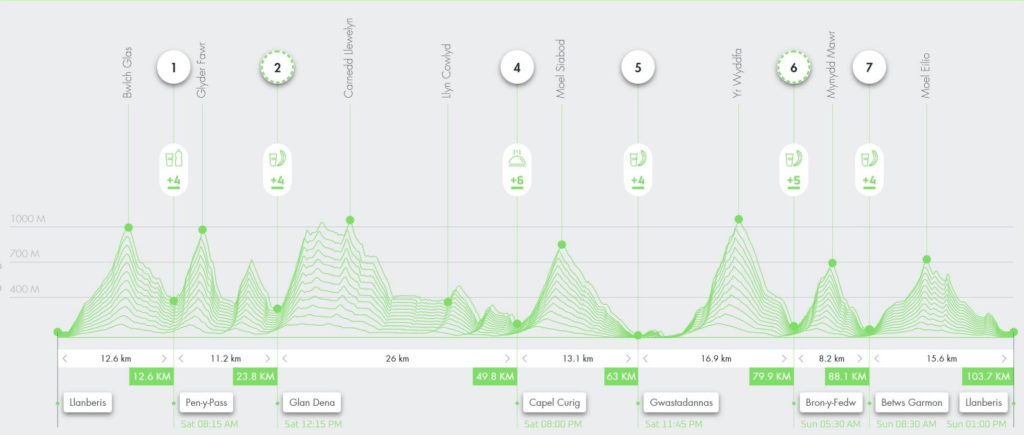
RACE WEEK. I’ve got a cold. Teaching last week let the germs shift from children to me. Mind you I’d far rather have a cold the weekend before, let it work it’s way through and be relatively recovered come this Saturday.
Tapering has gone well. After the niggle in my right hip a couple of weeks ago, the week of hard cycling paid off and I’ve had a very upbeat week of running. Feeling strong and ready. The run I did on Saturday – 16k including 3 x 12mins @ relaxed tempo felt great. Afterwards I didn’t feel as if I’d done anything. So fitness is there (fingers crossed the cold doesn’t take too much out of me). What I have been weighing up is how accurate can I forecast what happens on the day. Bearing in mind I’ve never done somethign like this before and the conditions make it really hard to accurately manage. However I don’t see that as a reason not to try and look at what this spits out.
After having a play around with a couple of things I settled on using below as a rough calculation to ascertain how long certain sections would take. I’ve only used this to give me an estimation for the uphills – any suggestions as to how to work out the downhills / adjust what I have done would be gladly accepted.
- Set a baseline “All day easy” running speed – for this 5:15/km on a 0% gradient
- Took the pace for a couple of recent runs where I could remember what the conditions & terrain and my moving was like – here was 10% gradient power hiking @ 11m 30s / km
3 Subtract 1. from 2. (11:30 – 5:15 = 6m15s) and divided by the gradient (6m15s or 375s / 10 = 37.5s)
I then had a weighted number for what every 1% gradient was worth – so here 37.5sec. - I then used this against the gradient/distance of each section to give me a rough estimate of how long it would take.
Section 1 is 7.7km with 888m of ascent – 12% gradient.
12 (gradient) x 37.5s = 7m 12s. Add this to baseline time = 5m15s + 7m 12s = 12m 27s / km
12m 27s x 7.7km (distance of climb) = 1h 36m to reach top of climb.
This has spat out what I think are some pretty accurate times, to use as a starting point.
I haven’t weighted for fatigue as the race progresses – mainly as this seems really hard to assess and the paces I used to gauge my running were from fatigued states.
I’m also seeing this as a guide, to help me plan roughly where I expect to be when – which my wife is very happy about. Also to gauge how long it may take to finish. My goal is to end in the same calendar day, which I think is achievable, everything else being equal. - Add in time at the aid stations for rest / food / refuel
This is what I currently have:
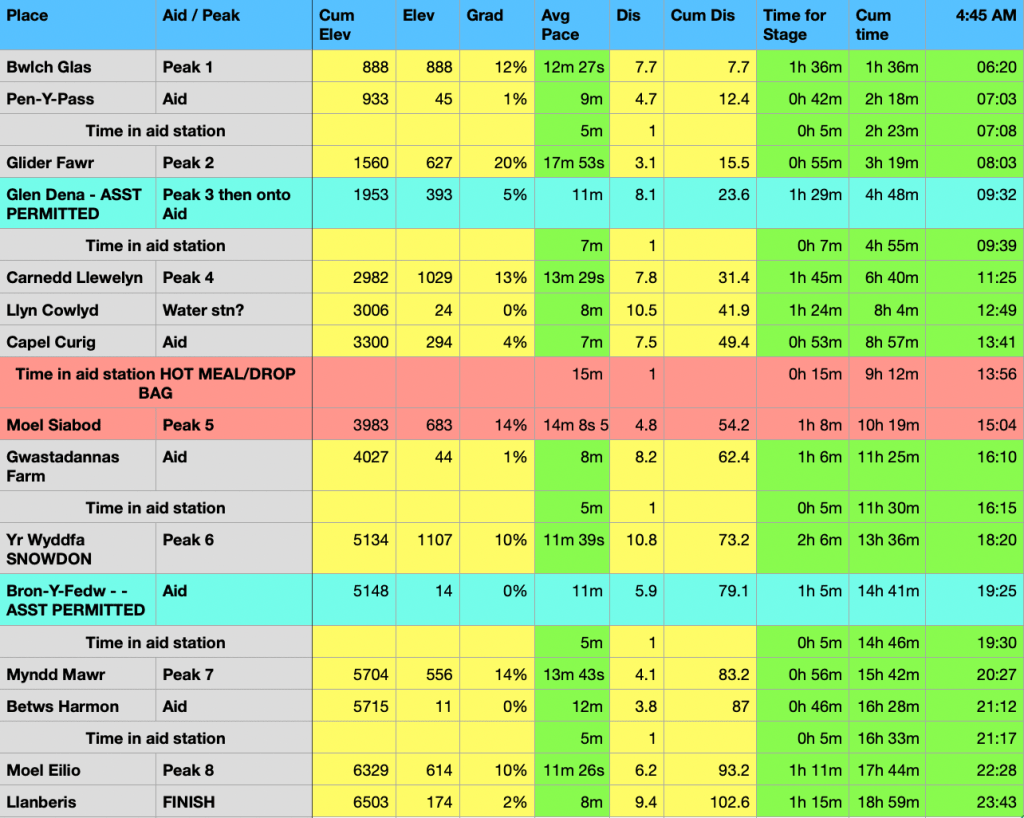
So a predicted finish of 11:43pm – which I’ll take as my goal is to finish in the same calendar day. It’ll be interesting to see how accurate this is following the event.
 BreatheToMove