I thoroughly enjoyed watching the marathon yesterday – both men’s and women’s races were very enjoyable, in different ways.
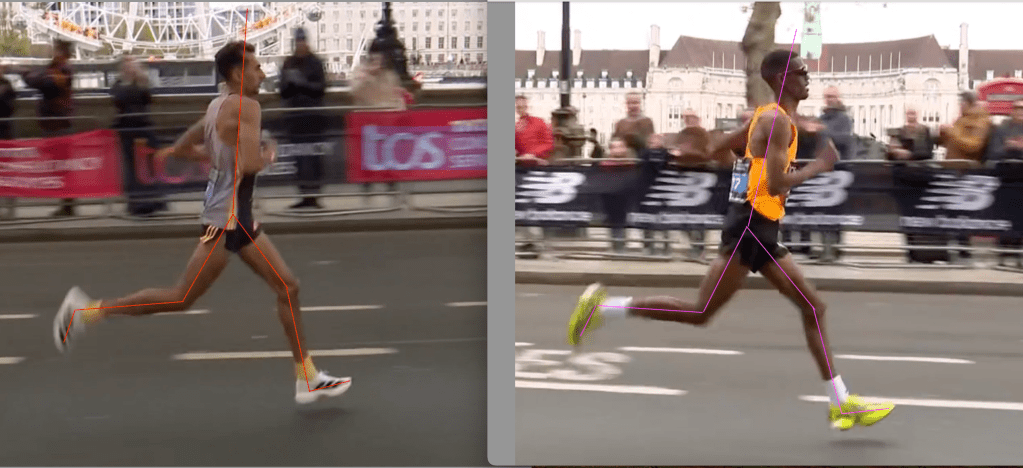
One of the things I really enjoyed was watching Emile Cairess (2:06:46) & Mahamed Mahamed (2:07:05) storm through the field, over the last few miles to come 3rd & 4th in what proved to be 2nd & 3rd all-time British performances. Both have made brilliant progress, and surely have more to give. I was curious about how different their running styles were and went back to look at the footage to see if there was anything unusual or different that set them apart. So I found the video from the BBC and spent time re-watching and looking at how one another compared, which is where the above still comes from.
Below both the guys were between 24-25 miles, deep into the race and at this point you would expect any challenges to form to be exposed by fatigue. Both look relaxed and – as you would expect from runners of this calibre – run in a way that helps them perform to their best, rather (as in my case and most others) begin to fall apart, looked really ragged and make the whole thing a lot harder.
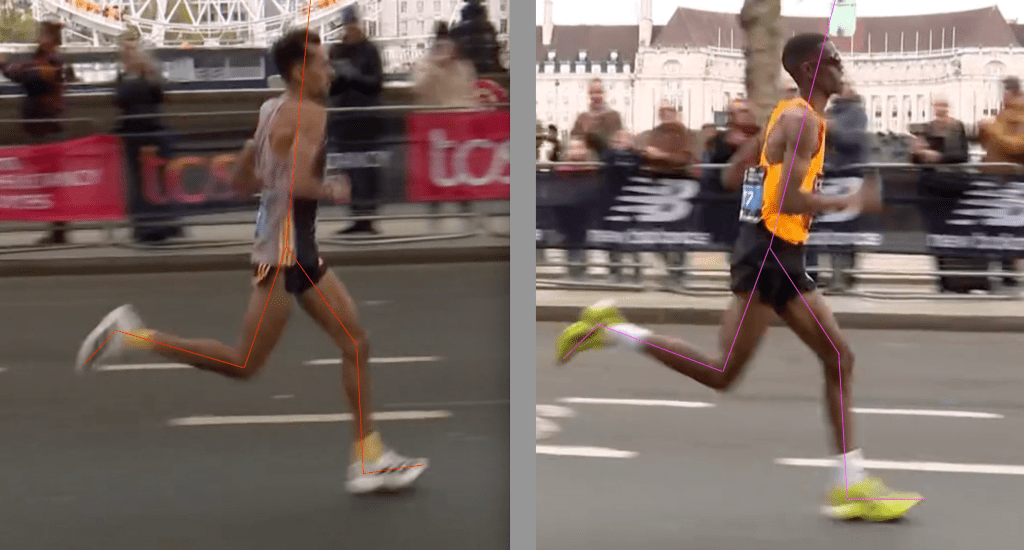
Looking at them both here, just at foot strike on their left foot, both have set up their feet well. Ankles on the strike foot at almost at 90 degrees allowing a decent foot contact, which can absorb the ground reaction force / load and then release. Between the 2 the main difference was the more pronounced lean of Mahamed (suggesting a possible slightly more anterior tilt of the pelvis). This difference seen in the image at the very top of the page as well.
Something else that is noticeably different between the two is how the swing leg behaves as it comes though. The very top image is a still from when the swing foot has gone out as far as possible, before being brought down onto the ground for support. With Cairess his leg unfolds and remains slightly more flexed (or bent) than Mahamed’s – whose leg tends to drift out a little more. Cairess has a more dorsiflexed ankle in this position and has less work to do to pre foot strike. However Mahamed naturally pulls his foot back underneath him, dorsiflexing the ankle to allow for a solid footstrike closer to his centre of mass than initially would seem the case.
This difference is interesting as I wonder how it plays out for both of them over the course of a marathon – and maybe the difference between Cairess always being the slightly smoother runner. With his swing leg coming through, unfolding & beginning to then initiating foot strike with a more dorsiflexed ankle this could well lead to a better / fuller foot contact, combining both vertical force exchange (as the foot comes down from above) with horizontal force exchange (as the centre of mass moves over the foot). Whereas for Mahamed as his swing leg comes through, he lets his front foot dangle a little more in front of him, which he then changes to dorsiflexing his ankle as he draws his foot back pre ground contact – but is this at the expense of slightly less vertical force exchange and too much horizontal force exchange. This coupled with the slightly greater forward lean from the hips may see an ever so slightly less economical & efficient running style that hands Cairess an advantage over such a long distance.
I wonder if the lean from the hips reflects a slightly more limited range of pelvic rotation / movement, which in turn would suggest an ever so slightly more limited ability to extend the hip, through the same range of motion as Cairess, using the free energy created from stretching the hip flexors as the stance leg passes underneath the centre of mass pre toe off. When you look at the point of hip extension, here it is clear that Cairess is getting a better range & more free energy:
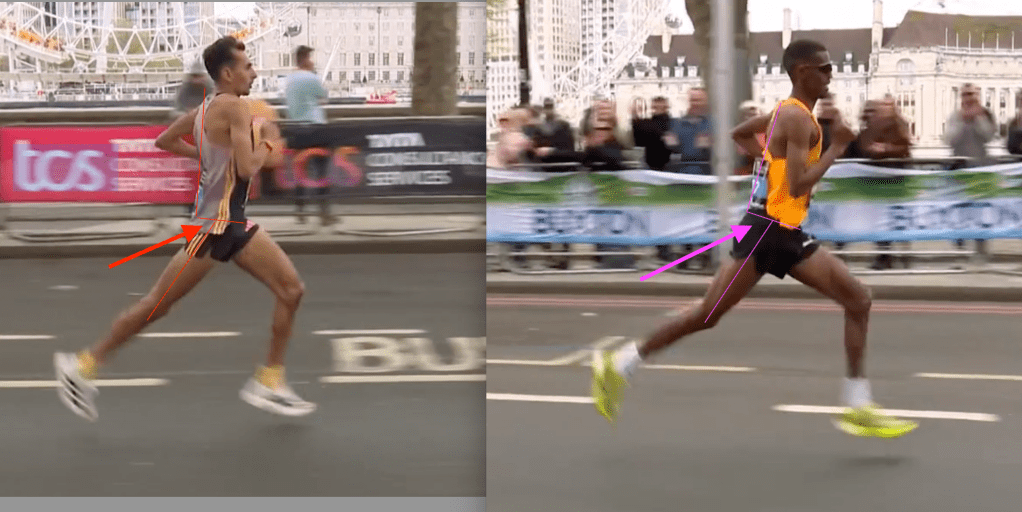
Looking at the pelvic tilt & position of the spine Cairess tighter angle at the back (red arrow) means a greater angle & stretch in the front for his hip flexors, which in turn will lead to a more powerful pull through of the swing leg, setting up the foot for a better action as it comes through and the opportunity to place greater force into the ground on next strike.
Both are great runners, both looked smooth and ran lifetime best efforts. None of above is a suggestion that either should look to change their running form. More something observational around what could happen in the future as they carry on to race. To me it looks like Emile Cairess has a style that gives him enough of an advantage over the marathon distance and if both had (as they did here) successful injury free training blocks I’d always see Cairess having the edge
 BreatheToMove