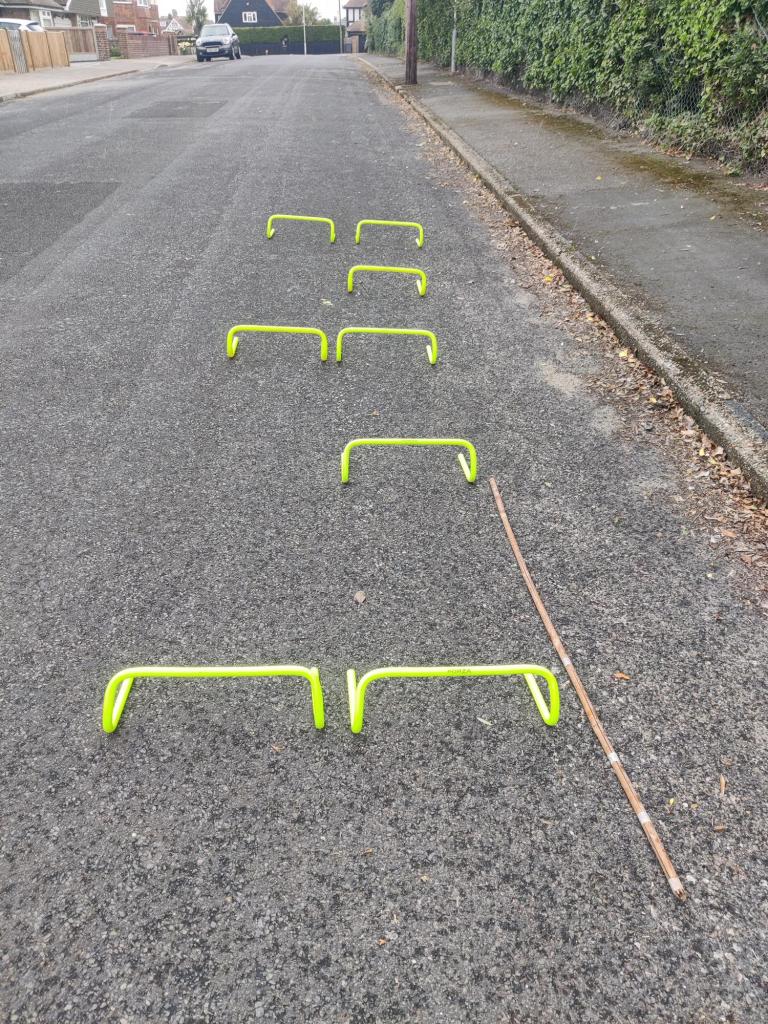
I became introduced mini hurdles / wickets on the wonderful Scholar program (Steve Magness & Jon Marcus’ online coaching support network). Jon is a big proponent of them – due to how well they help develop and improve (reactive) running form / technique. In very simplistic terms they act as a constraint to help encourage a runner to get their foot down, reducing over striding, allowing for a far more effective use of energy, better engagement of the fascial system and ultimately making running a smoother easier process.
Having tried them myself they do make a big, big difference – and once you have recognised the positive impact and what it feels like it is pretty impossible to ignore NOR want to ignore and revert to previous running styles (I regularly can hear a voice in my head reminding me to get my feet down and back, get a little more upright to allow this to happen). With this in mind I thought it was critical to introduce them with anyone I coached – especially the juniors. When I introduced to the juniors, some took to it immediately, like a duck to water, getting their feet down, just in front of the wicket they had run over. However not all the juniors (nor adults) did take to it naturally and so I developed some baby steps to really help all of the juniors get to grips with how to “feel” the difference. a What follows if what I’ve learned to date through observation / feedback.
Stage 1: Wall heel to hamstrings (or crushing fruit)
I noticed how similar the position of the swing leg was, when those who got wickets, was to the action encouraged in ankling, or higher heels up to hamstrings. This a drill that I really like, as it gets runners away from the misunderstood and mis-taught butt kicks (where is the action desirable in the running cycle?). So my first step is to really reinforce this action / movement. The first time I wanted the juniors to walk through this it was a disaster, so I took it right back and made 2 key adjustments as per below.
- Everyone stood against a wall, to focus on bringing their heel up to the top of their hamstrings
- The cue I gave was them to imagine a grape / small tomato behind your knees that you had to squash by bringing your heel up to your hamstring.
The wall helped keep them tall, the cue of squashing fruity encouraging the knee to lift in front:
Step 2 – Wall heel to hamstrings (or crushing fruit) walk outs
Next I’d get them to confidently walk on the spot, get the feel of the motion – key here of getting the foot DOWN and the knee up in front, still squashing fruit. Next was the walk forwards. Here I begin to notice toes either pointing at the ground as the heel lifted, or as was wanted an effort being made to keep the toes pointing up, allowing the extensor chain to lengthen and preparing the foot for a more balanced and effective loading position on landing. One cue I gave here (which I don’t think I use below) is hands in front, like pulling on a string that was lifting knees and toes.
Step 3 – Wall heel to hamstrings (or crushing fruit) run outs in a ladder
I then moved the juniors onto speeding this up. When I did this by asking them to shift from a walk to a run it was too challenging for many of them. So I added in a constraint, which was a ladder. This stopped those who where double bouncing / hopping, as each rung on the ground focused the mind on getting the foot down. Another top for my ladders was to mark the spot I wanted each rung with masking tape. The ladder rungs aren’t fixed and they move every single session. Having guidelines is a godsend as I know where to move the rungs to without having to measure.
The nice thing about this drill is that it is very, very similar to wickets itself, just having each rung closer together than the wickets are. Alongside which it helps to reinforce the movement pattern I want to see the juniors carry out.
Step 4 – Hopping over the wickets.
What I then did was have 2 sets of wickets ready. One of 4 wickets for hopping, all around 2m or 6ft apart. One next to these of 6 wickets, 1m or 3ft apart, with a cone where I wanted the foot to land before. I was finding that too many of the less coordinated juniors where drifting / pushing / leaping over the wickets when there were 10. So I thought break it down, reduce it and help give them a feeling of success, so part 1 of this was next. A tip here is having a measuring stick (bamboo with masking tape on it for me) to quickly measure the distances for each wicket. It also helps having the same coloured cones – different to the wickets themselves – to support what the juniors are looking for:
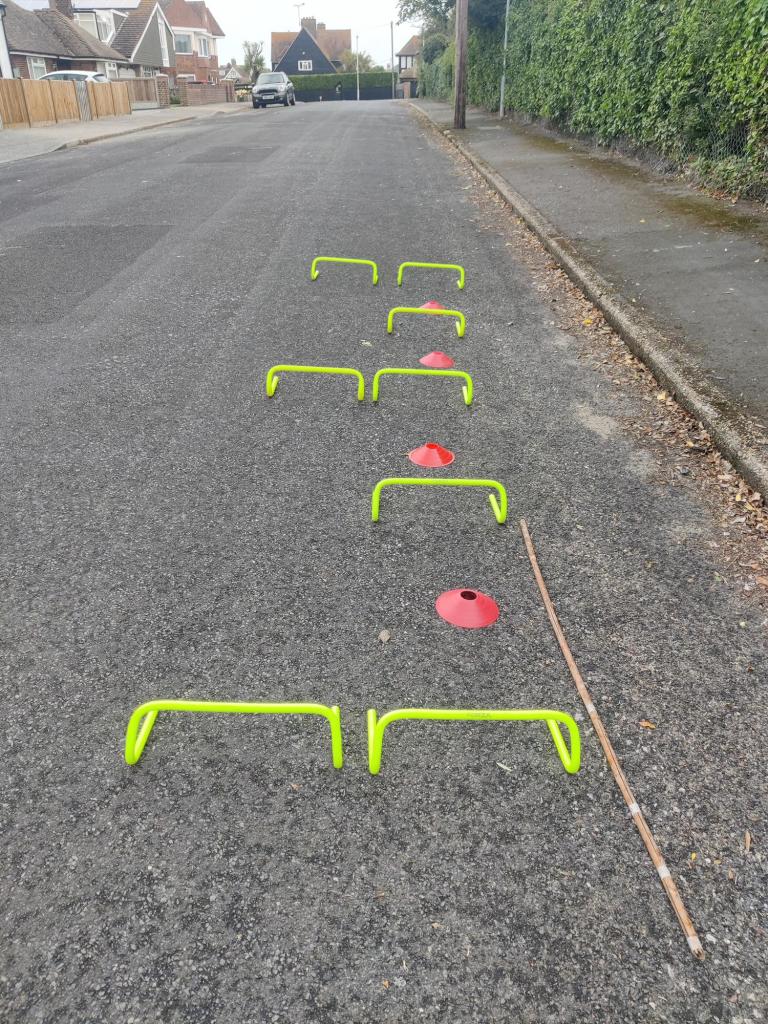
This I have found to be a key next step. One of the challenges that I have had to overcome is runners stepping forwards over the wicket and their feet landing too close to next wicket, as opposed to just in front of the one just cleared. To manage this I found that slowing the process down, to hopping over a handful of wickets (4) with your swing leg held in the position of heels to hamstrings really supported what was required:
As the juniors take off I’d encourage them to shout DOWN as they planted their swing leg. Key would be waiting until they were above the wicket (or as close as possible to being above it). This really helped improve timing and reducing stepping over the wickets early.
Step 5 – Running over the wickets.
Next I moved them out running through 6 wickets, no more. What this did is prevented many of them from racing through, and really helped reinforce the feeling of foot down / back and how this allowed them to interact with the ground. Adding the red cones a further constraint to direct where the foot is to land.
Step 5 – Increase the wickets.
When he juniors got this (after 4-5 run throughs) I’d add in 2 more wickets, to make it an 8 wicket run through:
For this I’d leave the red cones out of the new wickets- and encourage the juniors eyes to be on the horizon, imagine body nice and relaxed, whilst tall.
Step 6 – Film the run out
The final stage would then be to have 10 wickets and I’d film the run out to review (I’d have filmed at various points earlier, to use as feedback). For below I’ve not got the space to film 10 wickets, so just ran through 4 then out to illustrate the point”:
Once I could see success & the juniors could feel success (which is always great to see) they can then carry on running through 10 wickets with 20-30m run outs.
I still have a couple of juniors who struggle, so with these guys I reduced down the hopping to 2 hurdles (so 1 hop on each leg) and running through 4 wickets, then going again. This has made a huge positive difference to how they move & equally how they feel when they are taking part.
I am a big fan of wickets and see them as being a key tool in allowing runners to feel what it is like to use the ground & their body more effectively to run in a better smoother fashion (and the posture it encourages makes everything so much easier, breathing included) which is why I spent the time trying to work out smaller steps to help all of the juniors access their benefits.
 BreatheToMove
I heard the same podcast and I remember Jon talking about a positive knee angle. Is that something you look for as well? And when you speak about getting the foot down, is it about getting it down before it passes under the body? I’ve been focusing on extension in my stride the last couple weeks and my hamstrings and knees feel a little strained. I think I’m getting my legs too far behind me and it’s over stressing those joints.
LikeLike
You can never truly get the leg underneath the bodies centre of mass, it’s about trying to get it as close to it as possible. If this is something new, then like any new skills go easy. I’d also really, really recommend doing the heels to hamstrings / hopping / running drills pre wickets to help adjust to the movement. I’d add that once you’ve got your foot down, then rather than focus on extension, let your body do the work in response to putting your foot down. There could be a danger of paying too much attention, forcing this and then undoing the work in allowing the loading to happen after the foot is down.
LikeLike
I like the drills you provide to work up to wickets. What I’m saying is that I think by focusing on extension I’m getting too much backside and that triple ext position is stressing my joints. The outside of my left knee hurts some after my 14 mile long run yesterday. Wickets seems to promote a lot of frontside mechanics.
LikeLike