
One of the best, if not the best things I’ve bought over the last year has been a Garmin Tacx Flow Smart Trainer:
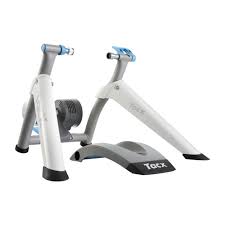
Which has been invaluable – in conjunction with my road bike & Zwift.
When I first came back into running, the first couple of years where OK in terms of avoiding long term injuries. I’d suffer from longer standing niggles, that would depend on some rest & consideration in helping heal. As time marched on and I upped what I was doing (sometimes far too much, sometimes ignoring signs and running through them) these niggles have taken longer to heal – or developed into something that qualifies as an injury.
My go to in this instance back in 2017-18 would be to jump on my road bike, look at what I had planned running wise and cycle for the same length of time. As pretty much all of my niggles / aches / pains have been from the knee down I’ve been able to continue to cycle (which in itself is a godsend as I’ve not yet experienced something that prevents me from moving more actively). As time went on I wanted to explore cycling more when these niggles cropped up and so my easy riding shifted into doing more tempo / interval based cycling around Regents Park, or Richmond Park. This all was fine up until mid 2022 when I suffered quite a sore achilles strain / tear. I begun to get frustrated with how cold my hands & feet could get on the bike and how stop start cycling in London was. With this in mind I considered buying a cycling trainer and using the Zwift platform. Part of me was pretty amused, as to me this was the equivalent of a treadmill for bikes, which for me personally using, is just something I cannot stand – I’d rather run in any weather (but absolutely get why some runners want the exactness of settings for training at top end levels). So I begun to Zwift, looking up training programs and following the instructions on the screen as how to ride, what power to put out, how fast to pedal, for how long and the position to take up on the bike. I was amazed by how much I enjoyed this and really, really got into seeing how far I could follow a training program.
At the same time I suffered the misfortune of getting one road bike stolen (outside a school I’d been supply teaching in) and also being knocked off my bike 3 times in 4 months – something that hadn’t happened to me in over 30 years of riding a bike in London. All of which reinforced how much I valued sticking my bike into the trainer, finding a ride to do and getting on with it indoors.
What I’ve now come to really, really appreciate is how versatile I’ve found the bike in supporting my running. Over the last 4-6 weeks it’s come into it’s own again and I’m considering how to use to support my running (which is still it’s primary purpose) leading up to Valencia. The following are where I see it playing a part:
- It allows me to do more work, for longer, at a lower heart rate without the mechanical load of running – helping maintain my aerobic capactiy
- It’s not weather dependant – so regardless of the weather I can get on the bike and cycle.
- Equally it’s safe, no traffic, no crash risk (notably as no rain)
- The training rides are ideal for me – I’m in no doubt that they are far from perfect – which is evident if you start researching Zwift riding on the internet, but for me they are more than good enough.
- I love the structure, the gradual progression in training and the equally noticeable progression in my ability to manage the extra load on a cycle
- I’ve found that when I do go back to running (as I did last week on Friday) the effort needed to run similar paces is less.
- They have been a great test bed in how to use breathing / breath holds for interval work to manage recovery and improve performance. One of the breathing tools I’ve been playing about with is within a 2 minute recovery section. 30 secs to allow the breath to normalise, then 3 to 4, 5 sec holds following 3 nasal rounds of breath. Finish with a 10 sec hold – which I find tough and can feel the release of oxygen / adrenaline by the end of the hold and really helps the muscles recover and work to a higher level when the next interval begins.
- I like to assess how easily I find it to breathe nasally on the bike, how this changes, when (or at which wattage) do I need to switch from nose only, to nos & mouth or just mouth. It changes regularly – both within and between rides. This seeming like a good opportunity to put the respiratory system / diaphragm under some resistance and train it.
- It makes me feel good – allowing me to work either hard or long, which when I can’t run to the level that promotes the same feeling is wonderful.
I was considering how long to have harder structured sessions in my training. I’ve currently settled up until the Great North Run and then transition to using the bike as a purely aerobic scaffold for my training. Whether this remains I’ll re-evaluate closer to the time.
 BreatheToMove